

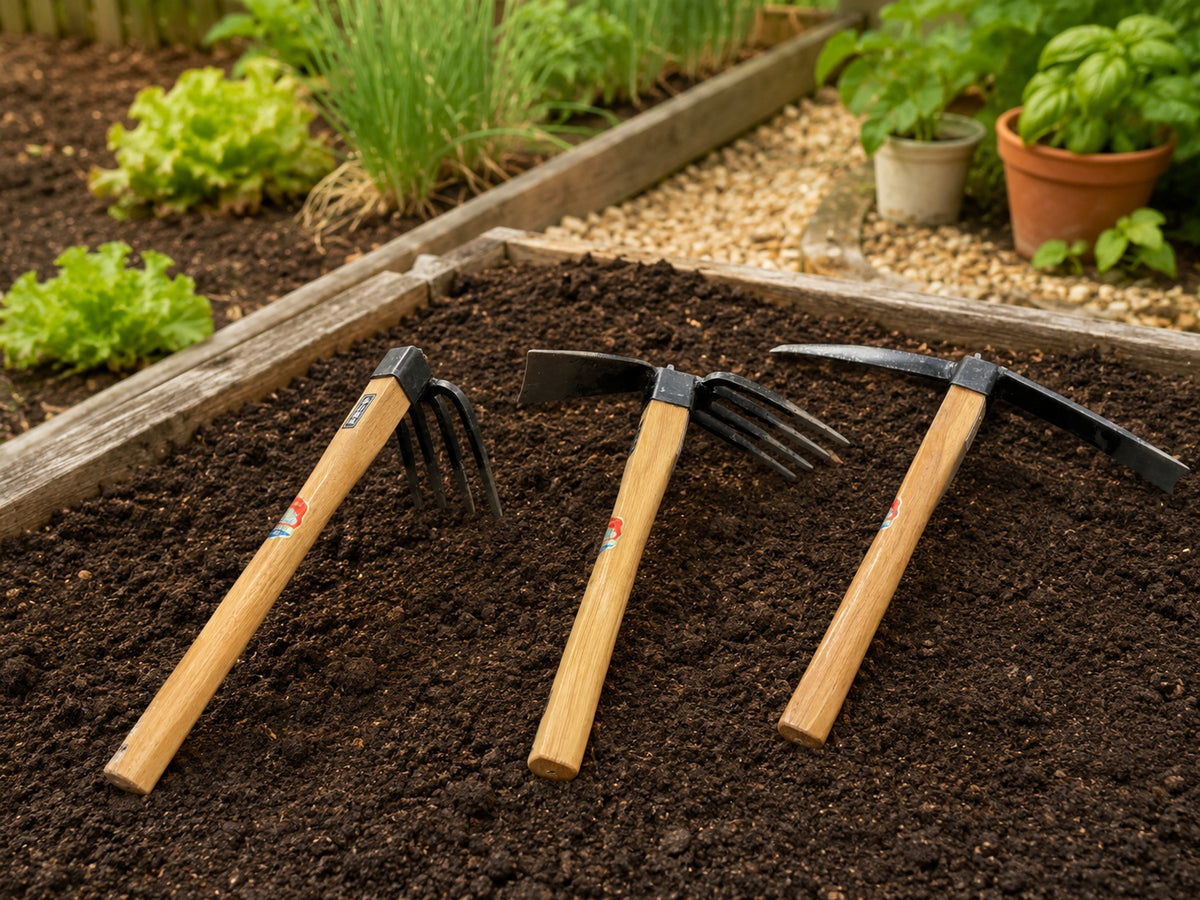
Azui’s No.101, No.102 and No.106 are all compact Japanese hand hoes, but they are not three sizes of the same tool. Each applies force to the soil in a different way. Choosing well comes down to the ground you work, how much control you need around established plants, and whether your main task is loosening, scraping or concentrated digging.
| Tool | Best for | Working character |
|---|---|---|
| No.101 | Light cultivation and aeration | Lightest and most controlled |
| No.102 | General cultivation and shallow weed scraping | Most versatile |
| No.106 | Firmer patches and compact digging | Most concentrated and forceful |
Quick answer: which Azui hand hoe should you choose?
For most gardeners buying one tool, the Azui No.102 Ika-Gata Hand Hoe is the broadest choice. Its four tines loosen soil, while its flat edge can scrape shallow weeds, break small clods and draw loose soil back into place.
Choose the Azui No.101 Four-Tine Hand Hoe when control matters more than force. It is better suited to established beds, close cultivation and keeping workable soil open without moving too much material.
Choose the Azui No.106 Pick Mattock when you regularly meet crusted surfaces or firm, localised patches that need a more concentrated strike. It delivers the most concentrated action of the three, but it is still a compact hand tool rather than a full-size mattock or pry bar.
Azui No.101: light, controlled cultivation
The No.101 has a simple four-tine head and the lightest working feel in the range. The narrow tines pass through workable soil with less disturbance than a broader hoe blade. That makes it useful around vegetables, herbs, perennials and other established plants where roots and stems leave little room for a heavy swing.

Best uses for the No.101
- Aerating the top layer of established garden beds.
- Loosening light to moderately workable soil before watering or feeding.
- Mixing compost or amendments into the surface.
- Disturbing very young weeds before they become established.
- Working between plants where a broader blade would remove too much soil.
The No.101 is not a dedicated scraping hoe. It can disturb young weeds and lift loose material, but it does not provide the flat cutting edge of the No.102. It is also the wrong choice for deeply compacted clay, levering rocks or cutting substantial roots.
Gardeners who mainly maintain prepared beds should consider the Azui Soil Preparation Duo. It pairs the controlled No.101 with the more versatile No.102, so one tool can loosen close to plants while the other handles broader cultivation and weed scraping.
Azui No.102: the most versatile Japanese hand hoe
The No.102 combines four cultivating tines with a flat hoe blade. This two-sided head is why it is the most practical single-tool choice for a mixed home garden. The tines loosen and open soil; the blade scrapes shallow weeds, breaks small clods and pulls loose soil into a planting area.

Best uses for the No.102
- General cultivation in vegetable beds and ornamental gardens.
- Shallow weed scraping on open soil.
- Breaking small clods after rain or watering.
- Preparing a modest planting area in already workable ground.
- Drawing loosened soil back around plants.
Its strength is range, not maximum force. It overlaps with the No.101 in light cultivation and with the No.106 in moderately firm patches, but it does not fully replace either. Around delicate established plants the No.101 gives finer control. In a hard crust or concentrated compacted spot the No.106 transfers force more directly.
For gardens with a mix of workable beds and stubborn patches, the Azui Tough Ground Set pairs the No.102 with the No.106. The No.106 opens the firm area first, then the No.102 breaks down, scrapes and levels the loosened soil.
Azui No.106: concentrated force for firm patches
The No.106 has the most concentrated and forceful action of the three. Its compact pick-mattock profile focuses each strike into a smaller area, making it useful for breaking a crusted surface, opening a narrow planting hole or working a localised patch that resists the No.101 and No.102.

Best uses for the No.106
- Breaking firm or crusted surface layers in small areas.
- Starting a narrow planting hole in resistant ground.
- Opening compacted patches before refining them with the No.102.
- Shaping soil in a disturbed area where a more concentrated tool is useful.
The No.106 is not a substitute for a full-size mattock, digging bar, shovel or axe. Do not use it to lever embedded rocks, pry against concrete edging, chop large woody roots or excavate a large area of hard ground. Those jobs create loads beyond the intended use of a compact hand tool.
If hard patches are only one part of your normal garden work, the Azui Complete Garden Cultivation Set gives the clearest progression: No.106 for the initial break, No.102 for general cultivation and scraping, and No.101 for controlled finishing around established plants.
Where the three tools overlap
All three can loosen soil, disturb small weeds and help prepare a garden bed. The difference is how they do it.
- No.101 and No.102: both cultivate workable soil. The No.101 is lighter and more precise; the No.102 adds a flat scraping edge and moves more material.
- No.102 and No.106: both can work a moderately firm patch. The No.102 is more useful after the soil begins to move; the No.106 is better for the first concentrated break.
- No.101 and No.106: they sit at opposite ends of the range. One favours control in prepared beds; the other favours concentrated force in small resistant areas.
None is designed for deep trenching, large-scale excavation or repeated impact against stone. For broader digging work, compare the larger tools in the Japanese digging tools collection.
Which tool suits each garden job?
Established beds and close work
Choose the No.101. Its lighter head and narrow tines make it easier to loosen the surface without shifting too much soil around established roots. Add the No.102 when shallow scraping between rows is also a regular task.
Shallow weeding
Choose the No.102. Its flat blade can skim small weeds at or just below the surface. The No.101 can disturb seedlings in loose soil, but it is not as efficient when you need a controlled scraping cut.
Compacted or crusted patches
Choose the No.106 for small, local areas. Use short controlled strikes to open the surface, then switch to the No.102 to break down and level the loosened ground. For a whole bed of hard clay or rubble-filled soil, move to a full-size digging tool rather than forcing a hand hoe.
Planting work
For a small planting area in already workable soil, the No.102 is usually enough. In a firm surface, begin with the No.106 and finish with the No.102. For transplanting, dividing plants or cutting through fine roots, a hori hori knife may be the more direct planting tool. The Azui Planting and Pruning Set combines cultivation tools with pruning equipment for broader garden work.
When an Azui set makes more sense
The tools are more useful as a sequence than as near-duplicates. A set makes sense when your garden contains more than one soil condition or when you want to move from breaking to refining without forcing one tool to do every job.
- Soil Preparation Duo, No.101 + No.102: best for maintained beds, loose to moderately workable soil, aeration and routine shallow weeding.
- Tough Ground Set, No.102 + No.106: best where workable soil is mixed with firmer patches, crusted surfaces or compact planting spots.
- Complete Garden Cultivation Set, No.101 + No.102 + No.106: best when you want the full compact system, from concentrated breaking through general cultivation to controlled finishing.
Azui tools are also available in broader garden combinations. See the Cultivation and Pruning Set, Planting and Pruning Set, Complete Garden Work Set and Complete Garden Tool and Care Set. The full range is collected on the Azui Seisakusho collection page.
Limits: what these compact hand hoes are not for
A compact free-forged head can be effective within its intended work, but the tool’s shape and handle length still set clear limits. Avoid using any of these hoes for:
- Levering or prying embedded rocks.
- Striking concrete, brick, steel edging or buried construction waste.
- Chopping large roots.
- Deep excavation or trenching.
- Breaking a large area of dry, heavily compacted clay.
If the ground will not yield to short, controlled strokes, stop and use a larger tool suited to the load. This protects the free-forged head, eye and handle from leverage they were not designed to carry.
About Azui Seisakusho
These tools are made by Azui Seisakusho in Miki, Japan, using free-forging methods to shape each tool head under the hammer. Read more about why forged carbon steel is used in many Japanese garden tools.
After use, remove soil and moisture, dry the exposed metal and apply a light coat of oil before storage. The Japanese Tool Care Guide covers the basic routine, while the tool care and sharpening collection contains suitable maintenance products.
Final recommendation
Buy the No.102 when you want one Japanese hand hoe for the widest range of common garden work. Choose the No.101 for maintained beds and close, controlled cultivation. Add or choose the No.106 only when firm localised patches are a regular part of your garden.
For most gardeners, the real choice is between the Soil Preparation Duo for established workable beds and the Tough Ground Set for mixed or firmer ground. The Complete Garden Cultivation Set makes sense when all three working characters have a clear job in your garden.
Leave a comment