

A Japanese hand hoe is a compact soil-working tool designed for close, controlled work in garden beds. Depending on the shape of its head, it may loosen surface soil, aerate around established plants, disturb young weeds, scrape shallow growth, draw loose soil or open a small patch of firmer ground.
The term does not describe one universal pattern. Japanese agricultural tools developed in many specialised forms, and the shape of the head often tells you more about the intended work than the name alone.
What is a Japanese hand hoe?
Most Japanese hand hoes combine a short handle with a compact working head. They are used close to the soil, where the gardener can control the depth, direction and force of each stroke.
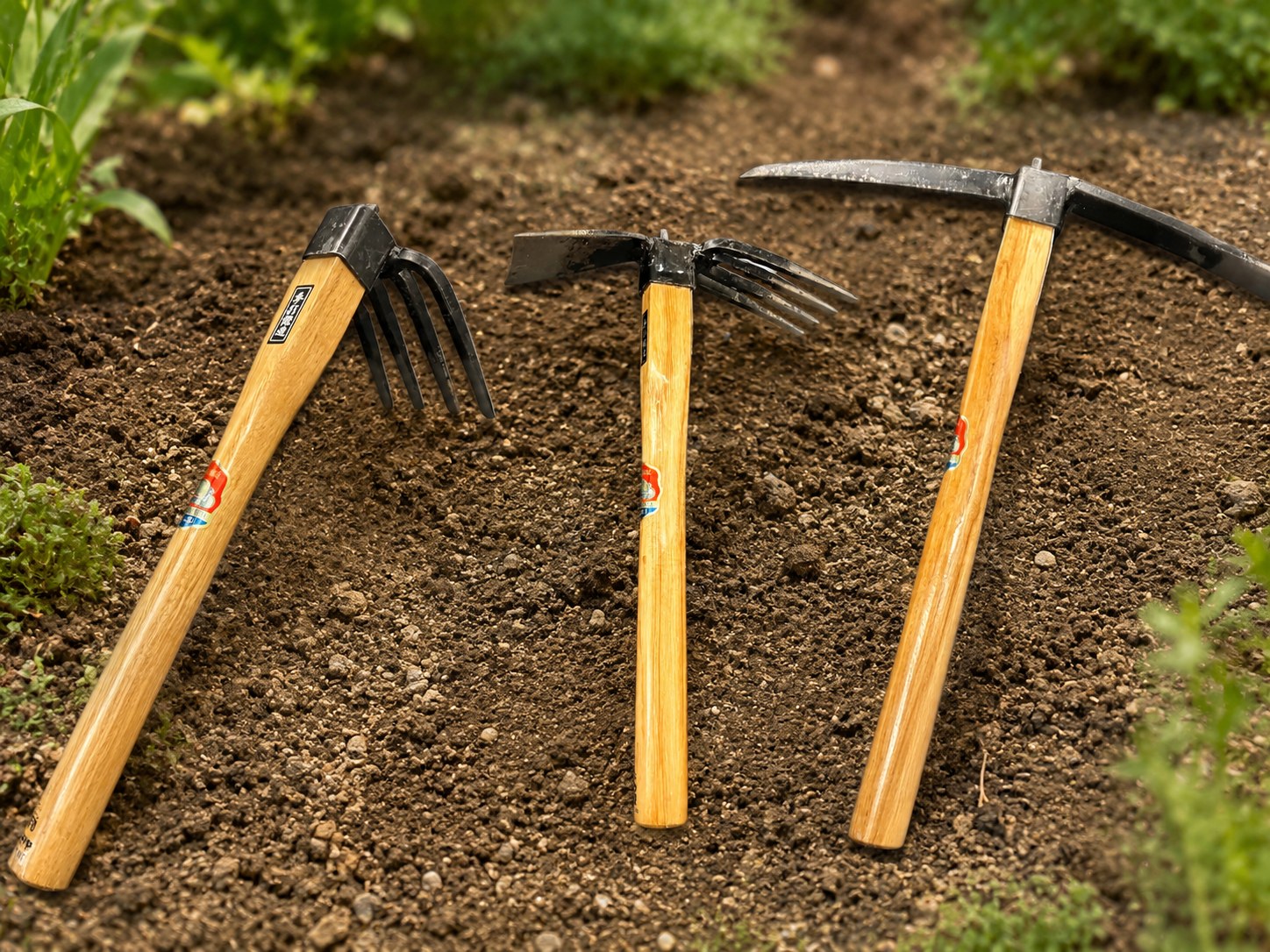
Some have narrow tines for loosening and aerating. Others combine tines with a small blade for cultivation and shallow weed scraping. Compact pick mattocks concentrate force into a smaller area for planting work or firm localised patches.
This close-working format is especially useful in established beds, raised beds, vegetable gardens and confined spaces where a long-handled tool would be difficult to place accurately.
Why do Japanese hoes come in so many shapes?
Japanese agricultural tools were not developed around the idea that one hoe should perform every job. Tool forms vary according to soil, crop, region, working method and the particular task being performed.
A light tine tool can move through workable soil with little disturbance. A small flat blade can scrape shallow weeds or draw loose soil. A pointed pick can enter a firm patch more readily than fine tines. None of these forms is automatically better than another. Each places force into the soil differently.
This is also why the Azui Seisakusho range includes three compact hoes with clearly different working characters rather than three sizes of the same tool.
How is a compact hand hoe different from a long-handled hoe?
A long-handled hoe is generally better for covering a larger area while standing. Its reach makes it efficient for rows, broad beds and repeated surface work.
A compact hand hoe trades reach for control. It is easier to position between plants, beside irrigation lines, around bed edges and in narrow planting areas. The shorter handle also makes it easier to feel changes in resistance and reduce force near roots.
That control comes with a clear limitation. A compact hand hoe is not an efficient substitute for a long-handled hoe, mattock, digging fork or spade when the job involves a large area or deeply compacted ground.
Main types of compact Japanese soil tools
Tine cultivators
Tine cultivators loosen the upper layer of workable soil, break small clods and create air spaces without turning the bed deeply. They suit maintained soil where the goal is to preserve a good structure rather than break new ground.
The Azui No.101 Four-Tine Hand Hoe is the lightest and most controlled of the three core Azui tools. It is well suited to aerating established beds, incorporating a modest amount of compost and working carefully around plants.

Combination tine-and-blade hoes
A combination head provides two related functions. The tines loosen and cultivate while the flat edge can scrape shallow weeds, draw loose soil or level a small area.
The Azui No.102 Ika-Gata Hand Hoe is the broadest general-purpose option in the Azui range. It is the strongest starting point for a gardener wanting one compact tool for mixed everyday work.

Compact pick mattocks
A compact pick mattock focuses each short strike into a defined area. It can open a crusted surface, begin a narrow planting hole or break a small firm patch before a lighter cultivator finishes the soil.
The Azui No.106 Pick Mattock is intended for concentrated breaking and compact digging. It is not intended for levering rocks, chopping substantial roots or replacing a full-sized mattock across a large area.

Planting knives and hori hori
A hori hori belongs to the same broader family of close-working garden tools, but it is not a hand hoe. Its narrow blade is better suited to planting, dividing and cutting small roots. A hand hoe is generally better at loosening, moving or shaping the soil around the planting position.
Many gardeners find the two formats complementary rather than interchangeable.
What jobs suit a Japanese hand hoe?
Aerating maintained beds
In soil that is already workable, fine tines can open the surface without turning over the whole bed. This can be useful between planting cycles, after rain has settled the surface or when incorporating compost into the upper layer.
Shallow cultivation and young weeds
Small weeds are easier to manage before they establish deep roots. A combination hoe can disturb seedlings or scrape shallow growth while cultivating the surrounding soil.
This is different from clearing mature, woody or deeply rooted weeds, which may require a Japanese sickle or weeder, a hori hori or a larger digging tool.
Drawing and shaping loose soil
A small blade can pull loosened soil toward a plant, level a narrow row or close a planting hole. Compact tools are useful where only a modest amount of soil needs to move and nearby plants should remain undisturbed.
Preparing a small planting area
Where the surface is slightly crusted or locally firm, a compact pick mattock can begin the opening before a hori hori or planting tool refines the hole. This approach works well for isolated planting positions but is inefficient for excavating a large area.
Choosing a hand hoe for your soil
Loose or regularly maintained soil
For raised beds, established vegetable beds and soil that is already open and workable, a lighter tine cultivator is usually enough. The aim is to maintain structure rather than break the ground aggressively. The No.101 is the most controlled choice for this work.
Mixed garden beds and general maintenance
Where the work changes between cultivating, disturbing young weeds and drawing loose soil, a combination tool is more versatile. The No.102 is the strongest starting point for someone buying a single Azui hand hoe.
Firm localised patches
A compact pick mattock makes sense when parts of a bed become crusted, dry or noticeably firmer than the surrounding soil. The No.106 can open those patches before a lighter tool finishes the cultivation.
Large areas of hard or deeply compacted ground
A compact hand hoe is not the right first tool for extensive hardpan, heavy excavation or ground filled with large stones and substantial roots. Use a suitable long-handled mattock, digging fork, spade or other full-sized tool to establish the bed, then use a hand hoe for ongoing maintenance.
Which Azui hand hoe should you choose?
- No.101: best for light cultivation, aeration and controlled work around established plants.
- No.102: best for general cultivation, shallow weed scraping and gardeners wanting one versatile compact hoe.
- No.106: best for concentrated breaking, narrow planting work and firm localised patches.
For a detailed side-by-side explanation, read Azui No.101 vs No.102 vs No.106.
Do you need one tool or a set?
One tool is enough when your soil and routine are consistent. A gardener maintaining loose raised beds may use the No.101 for most work. Someone managing mixed beds and young weeds may be better served by the No.102 alone.
A set becomes useful when the soil changes across the garden or the work has distinct stages. The Azui Soil Preparation Duo pairs lighter cultivation with general-purpose soil work. The Azui Tough Ground Set combines the No.102 and No.106 for firmer conditions. The Complete Garden Cultivation Set covers the progression from concentrated breaking through general cultivation to careful finishing.
Basic technique
Begin with short, controlled strokes and work the surface before trying to go deeper. Let the head shape perform its intended job rather than forcing it through unsuitable ground.
- Use tines with a pulling or raking action in workable soil.
- Keep shallow weed scraping close to the surface.
- Use the pick end in a defined spot rather than swinging broadly.
- Reduce force around established plants and feel for major roots.
- Change to a larger tool when the ground will not yield.
Where compact hand hoes reach their limit
These tools are made for soil work, not as pry bars or demolition tools. Avoid levering against rocks, concrete edging or buried objects. Do not use fine tines to chop substantial roots, and do not expect a compact pick to replace a full-sized mattock across a large area.
Recognising those limits is part of choosing the right tool. A smaller tool can be strong and effective within its intended work while still being the wrong choice for heavy excavation.
Cleaning and care
Remove clinging soil after use, dry the head thoroughly and store the tool away from persistent moisture. If the tool will remain unused for a period, a light protective oil can help reduce rust.
Inspect the handle and head connection periodically, particularly after working firmer ground. For a broader maintenance routine, see the Japanese Tool Care Guide and the Japanese tool care collection.
A practical place to start
Choose according to the soil task you perform most often. For careful cultivation in maintained beds, start with a tine cultivator. For mixed everyday work, choose a combination hoe. For firm isolated patches, use a compact pick mattock and recognise when the job needs a larger tool.
You can view all three tools and the available sets in the Azui Seisakusho collection, read about the Azui Seisakusho workshop and toolmaking approach, or explore the wider Japanese digging and weeding tool range.
Leave a comment